
Focus Groups
The project aims to establish a set of interpretative criteria for analysing the transformations and current conditions of cemeteries within the geographical context of Western Europe, investigating how spatial, environmental and management characteristics influence experiences of well-being or discomfort among the communities and individuals who use these spaces. In this process, focus groups represent a central research tool: by involving the parties concerned with the life and management of cemeteries, they highlight perceptions, expectations, usage practices and critical issues, helping to build a solid empirical basis for the development and validation of the analytical framework.
Lampedusa
Lampedusa, Italy’s southernmost island in the heart of the Mediterranean, is a frontier region where the migration flows, the refugee reception policies and the dynamics of exclusion that often characterise contemporary Europe intertwine on a daily basis.
Its geographical and symbolic location, at the crossroads of the routes between North Africa and Europe, makes it an ideal vantage point from which to analyse the social changes linked to migration and the mechanisms that govern it.
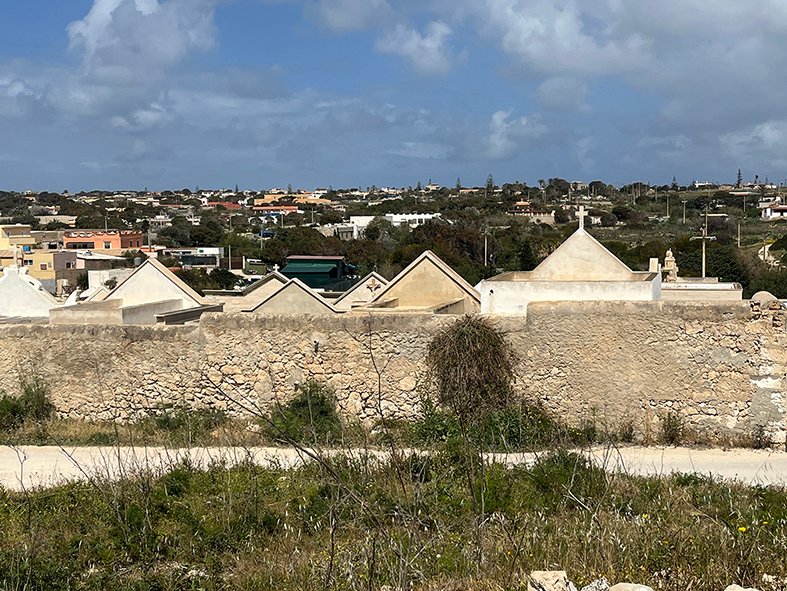
Cala Pisana cemetery in Lampedusa can be seen not only as a place that embodies the memory of the local community, but also as a place that highlights the most extreme consequences of migration in the Mediterranean: here lie the bodies of people who lost their lives during their journey; some of these are unmarked graves, with no documented history, serving as a tangible and symbolic expression of the often tragic outcome of migration.
The choice of Lampedusa as the focus group location for the ‘Making Space for the Other’ project stems from its ability to bring together, in a single place, the dimensions of the border, death and memory. In this sense, the cemetery becomes a lens through which to critically examine the relationship between space, otherness and inclusion in contemporary European societies.