
Publications
The abstracts collected reflect the diversity of perspectives that emerged during the conference entitled: " Public space / private space. The cemetery as a heterotopia?”.
Through different disciplinary approaches, the papers offer different perspectives that enrich the debate on the meaning and transformations of the cemetery, confirming its relevance within the discourse on the cohabitation of ethnic groups and on forms of living.
Rather than providing definitive answers, the papers open up fields of research with social, cultural, and design-oriented approaches, highlighting the centrality of these places within the dynamics of the contemporary societies contemporanee.
Andrew Benjamin
What is the Place of Death?
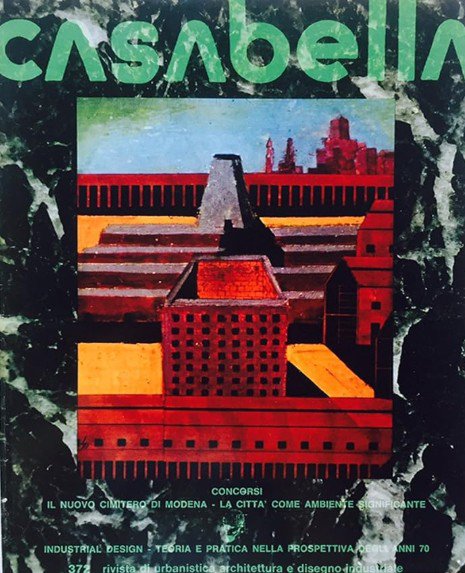
It is always possible that a cemetery may lack distinctive features, regardless of the city where it is located. In other words, there may be no clear distinction between the city of the living human beings and that of the dead. Aldo Rossi wrote the following words regarding his design for the San Cataldo cemetery in Modena.
«The central idea of this project was perhaps the discovery that the things, objects and structures of the dead are no different from those of the living».
In ‘Alternative per un concetto di monumentalità’, Casabella, n. 372. 1972, p. 2
If the distinctive character of the cemetery is to be recovered, whilst avoiding the conflation of life and death at the design level, then this can only happen once it is recognised that architecture has an inescapable relationship with life. The strength of this connection allows architecture to be understood, or reinterpreted, as the dwelling of life. If the cemetery is to be understood within the context of the interplay between architecture and philosophy, then the central issue must be life. It is precisely here that the philosophical problem of the relationship between life and death emerges with great clarity. The argument, therefore, is that architecture’s relationship with death is rooted in concerns about life. The way to address the unique nature of the cemetery is to start with a simple question: what is a cemetery without death?
Maria Elena Paniconi
A living necropolis
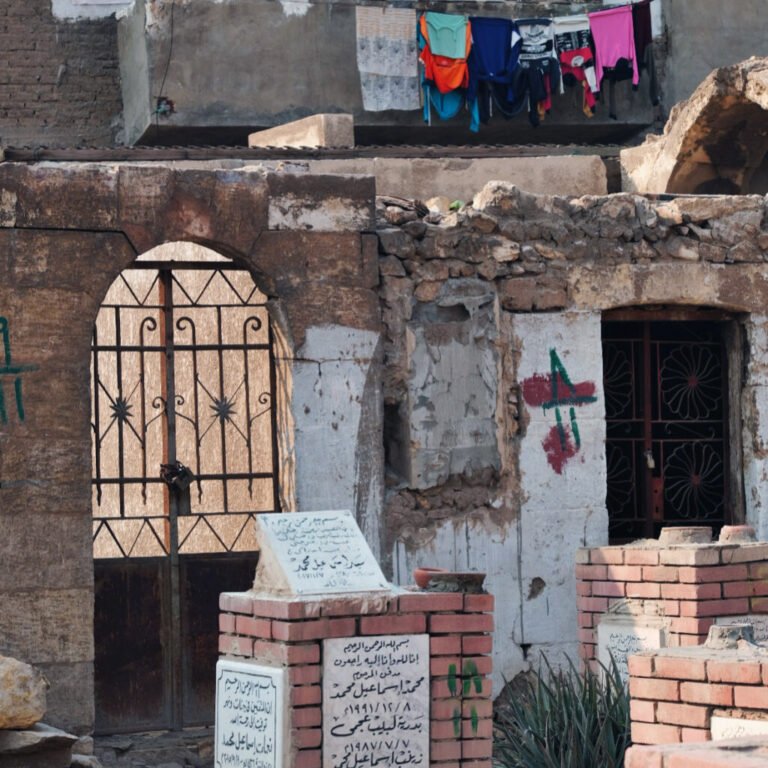
Since its origins in the 7th century, the monumental Islamic cemetery in Cairo, also known as City of the Dead (al-Qarafa), looks like a monumental funeral place, crossed and frequented by pilgrims, Sufis and scholars. According to early accounts, it appears to have been inhabited by functionaries and those responsible for its upkeep, as well as by those seeking the company of the saints and devout individuals buried there.
The stories of medieval travellers, such as Ibn Jubayr (12th century) and Ibn Battuta (14th century), attest to its architectural and spiritual richness, whilst later texts, up to the Mamluk period, describe its multifunctional nature. The area includes, in fact, mausoleums, ribāṭ, zāwiya e madrase funded by charitable foundations (awqāf).
From the 1970s onwards, as population pressure and housing crises intensified, al-Qarafa also became a site of informal settlement, eventually coming to house up to half a million residents, including many people living illegally on the tombs. Al-Qarafa has grown into a town within a town, housing residential areas complete with basic services and infrastructure.
The necropolis, place of paradoxes and stratifications, has inspired many authors in Arabic-language Egyptian literature, from Muwaylihi—author of an important neo-maqama from the early 20th century—to Mahfouz, and right up to the contemporary poet and novelist Iman Mersal. A literary analysis of these authors’ works reveals the constant reconfiguration of spatial and temporal coordinates made possible by this specific inhabited area, capable of containing and reflecting tensions between the sacred and the profane, memory and marginality, death and urban survival.
Daria Pezzoli-Olgiati
The National Covid Memorial in London as a Funerary Practice
This paper is focused on the transformations of the funeral customs during and in the aftermath of the pandemic Covid -19. In Europe, the cemetery as a separate space within urban areas became common in the modern era, mainly thanks to municipal or private initiatives aimed at resolving the problem of overcrowding in religious burial grounds. In recent decades, the modern cemetery, understood as a burial place dedicated to the memory of the deceased, has been called into question by new needs and by new approaches to funeral practices. The pandemic has radically changed our relationship with death and burial. The body of the deceased has become a threat, and the need to manage the high number of deaths has made efficiency a priority. During lockdowns, funerals were reduced to nothing more than a simple burial, with no opportunity for the bereaved community to gather together.
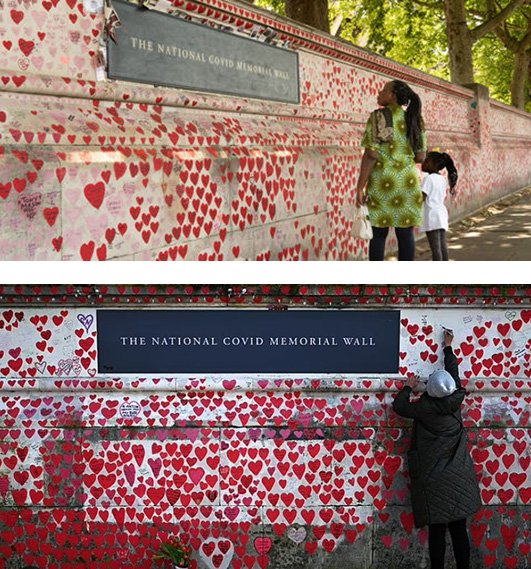
In this situation, the London National Covid Memorial was started to address the lack of collective mourning and as a form of protest against the political handling of the pandemic. The Memorial Wall represents a shift in established cemetery practices, involving processes of representation, production and engagement, as well as issues relating to regulation and identity.
The Covid-19 Bereaved Families for Justice collective has begun painting red hearts on a wall on the south bank of the Thames, in full view of Parliament. The initiative began on 29 March 2021, using street art as a means of engaging various stakeholders in the public sphere. Today the mural features over 240,000 hearts, each representing a person in the UK who has died from SARS-CoV-2. The monumental work has become a spontaneous national memorial, the legal status of which remains a matter of controversy. It is maintained by a group of volunteers known as The Friends of the Wall.
Giorgio Trentin
Sepulchral spaces: beyond nothingness and the the cultivation of human hearths. An interpretation of the cultural signification of Chinese cemeteries
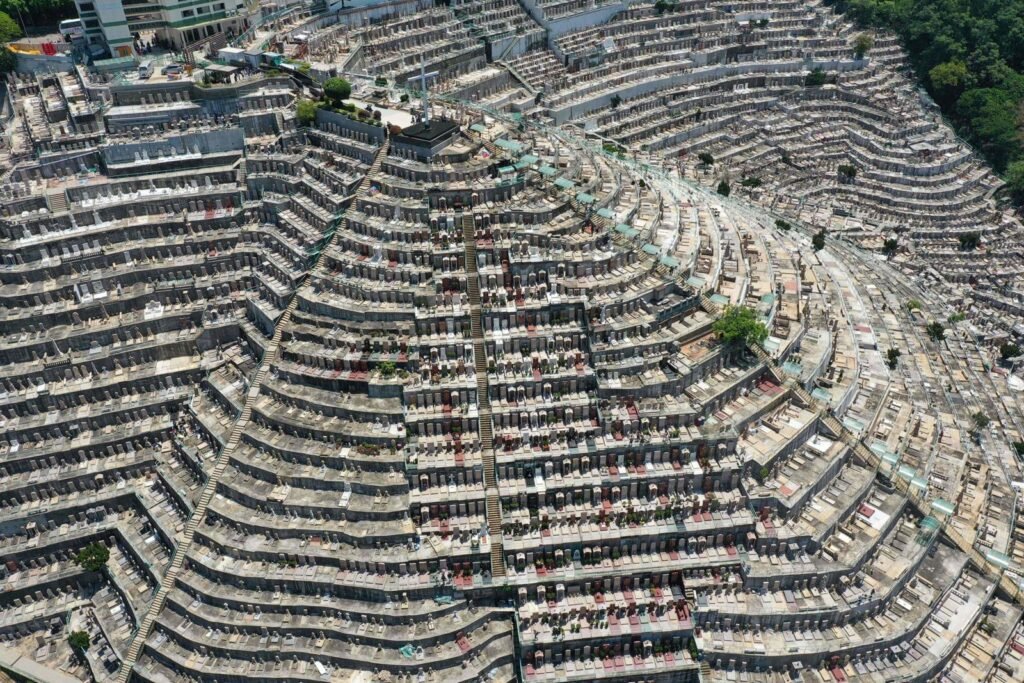
In China, cemeteries are cultural spaces of great significance that embody complex conceptions of death and fulfil various socio-psychological functions.
Historically, Chinese burial places have reflected the individual’s struggle against existential nothingness and the need to take care of the moral values in Chinese society.
In modern China, traditional practices coexist with the increasing secularisation of funeral rites. While urban public cemeteries face more and more severe space constraints, in rural areas family or clan burials retain their distinctive characteristics.
Addressing the spiritual void in an ever more secularised society is one of the challenges facing China today, and preserving the cultural continuity embodied by traditional burial sites and the rituals associated with them is undoubtedly a significant part of this challenge.
1
Gabriele De Anna
Intimacy and the limits of authority
The paper explores the public dimension of the cemetery as a heterotopic space, focusing on three issues: the legitimisation of post-mortem inequalities, the difficult harmonisation of cultural and religious practices, and the the overlap between the public and private spheres in the regulation of death. At the heart of the analysis lies the question of how the authorities define the boundaries between the public and the private, between the personal and the social.
Starting from Foucault’s concept of heterotopia, this paper demonstrates how the cemetery, even though it is configured as “space of otherness", is deeply rooted in the social world and its normative dynamics. Practices linked to birth, life and death, which are universal yet historically determined, shape both the social body and the spaces of burial.
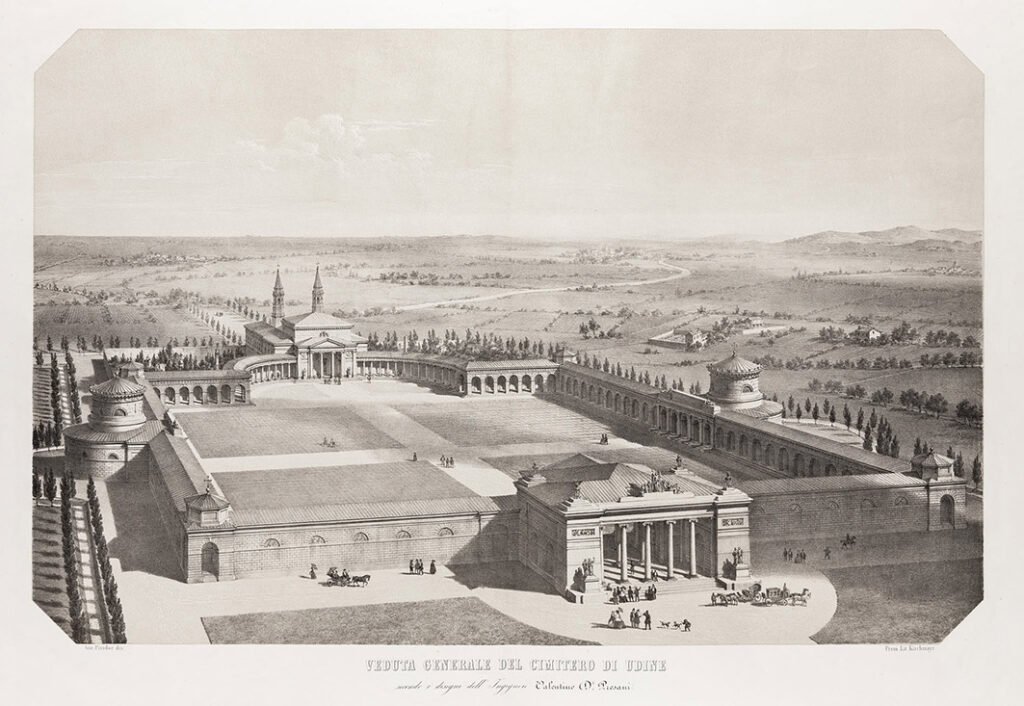
By analysing the case of San Vito Monumental Cemetery in Udinethe tension between formal equality and material inequality in death is highlighted. The analysis also addresses the issue of the representation of cultural and religious diversity within a shared space, demonstrating how religions, secular norms, health requirements and social dynamics all contribute to defining the forms of the cemetery as a heterotopia.
The cemetery emerges as a prime setting for examining the regulatory tensions within contemporary society and the ongoing process of redefining the common good.
CALL FOR PAPER
“Itinerari”, n. 1, 2027
Tra luogo dell’intimo e spazio pubblico. La vita dei cimiteri
Questo numero di Itinerari (nato nell’ambito del progetto di ricerca PRIN 2022 – Making Space for the Other. Cemeteries as Performing Places for Inclusive, Safe, Resilient Societies: an Interdisciplinary Project) si propone di esaminare i cimiteri come luoghi peculiari che, da un lato, mettono in evidenza le contraddizioni insite nella vita sociale e, dall’altro, offrono le condizioni necessarie per immaginare società più eque e inclusive.
La natura liminale dei cimiteri — intesi come spazi di transizione tra vita e morte, tra sfera pubblica e privata, nonché tra dimensione sacra e profana — offre un quadro teorico coerente per interpretare diversi contesti. Essi, ad esempio, rendono visibili le disuguaglianze sociali attraverso la loro configurazione spaziale e le modalità di accesso, manifestano conflitti politici e razziali attraverso pratiche di “necroviolenza” e atti di profanazione di cui sono oggetto, e risultano influenzati da pressioni economiche legate all’uso del suolo e al valore immobiliare. Queste dinamiche mostrano la capacità della cultura cimiteriale di articolare biografie individuali, mentalità, credenze religiose e strutture sociali, contribuendo così alla produzione di significato e identità, nonché alla costruzione di forme di inclusione o separazione.
Between the intimate and the public Space. The Life of Cemeteries
This issue of ‘Itinerari’ (which originated within the research project PRIN 2022 – Making Space for the Other. Cemeteries as performing Places for inclusive, safe, resilient Societies: an interdisciplinary Project) endeavors to examine cemeteries as unique places that, on one hand, highlight the contradictions inherent in social life, and, on the other, provide the conditions necessary for envisioning more equitable and inclusive societies.
The liminal nature of cemeteries—serving as a transitional space between life and death, public and private spheres, as well as sacred and profane domains—offers a coherent theoretical framework for interpreting various contexts. For instance, they reveal social inequalities through their spatial configuration and modes of access, manifest political and racial conflicts via practices of ‘necroviolence’ and desecration to which they are subjected and are influenced by economic pressures related to land use and property values. These developments demonstrate the capacity of cemetery culture to articulate individual biographies, mentalities, religious beliefs, and social structures, thereby creating meaning and identity, as well as fostering acceptance or separation.